Shadow AI Puts Sensitive Data One Paste Away From Leaving

Generative AI is now part of daily work and daily life. That speed created a new class of risk: shadow AI — employees using public GenAI tools outside approved channels, often through personal accounts, where sensitive data can leave before security teams know.

Definition

What is shadow AI?

Shadow AI is the use of AI tools or features without formal approval, procurement, or security oversight. It often looks like productivity: drafting in ChatGPT, summarizing in a free assistant, debugging in an unsanctioned coding bot. The threat is not “AI exists” — it is uncontrolled access and invisible data flows.
Cited indicators of awareness vs. control

Every figure below is tied to a named source and year. Definitions of shadow AI vary by study; we keep those years visible.

69%

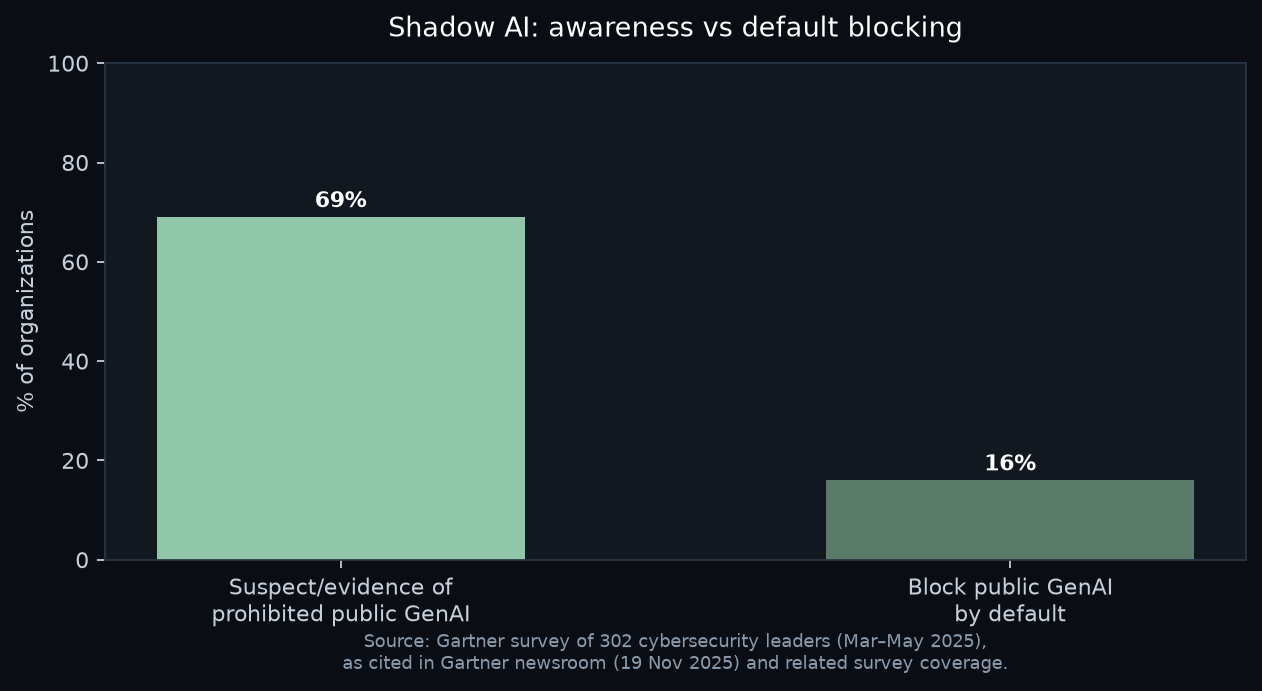
of organizations suspect or have evidence that employees use prohibited public GenAI

Gartner survey of 302 cybersecurity leaders (Mar–May 2025), cited in Gartner newsroom, 19 Nov 2025

>40%

of enterprises are predicted to experience security or compliance incidents linked to unauthorized shadow AI by 2030

Gartner prediction, same newsroom release (19 Nov 2025)

16%

of organizations block public generative AI by default

Gartner 2025 Cybersecurity Innovations in AI Risk Management and Use survey, as reported in industry coverage summarizing the survey

Bar chart comparing 69% of organizations that suspect or have evidence of prohibited public GenAI use versus 16% that block public GenAI by default.
Source: Gartner survey of 302 cybersecurity leaders (Mar–May 2025), as cited in Gartner newsroom (19 Nov 2025) and related survey coverage. Chart: awareness/evidence of prohibited public GenAI (69%) vs. default blocking (16%).

Additional vendor studies report high paste rates into GenAI and rising sensitive content shares; treat those as directional unless a specific secondary source is named on-page.

Why legacy controls miss it

  • GenAI traffic often looks like normal web browsing
  • New tools appear weekly (see AI Platforms)
  • Personal logins bypass corporate SaaS visibility
  • After-the-fact alerts do not undo a paste into a public model

Workplace GenAI keeps expanding

AI in the workplace is no longer one chatbot. It includes consumer assistants, embedded AI in productivity suites, coding agents, image/video tools, and meeting note-takers. Consumer life trains the same habit: open a tab, paste context, get an answer. That habit crossed into work faster than many governance programs.

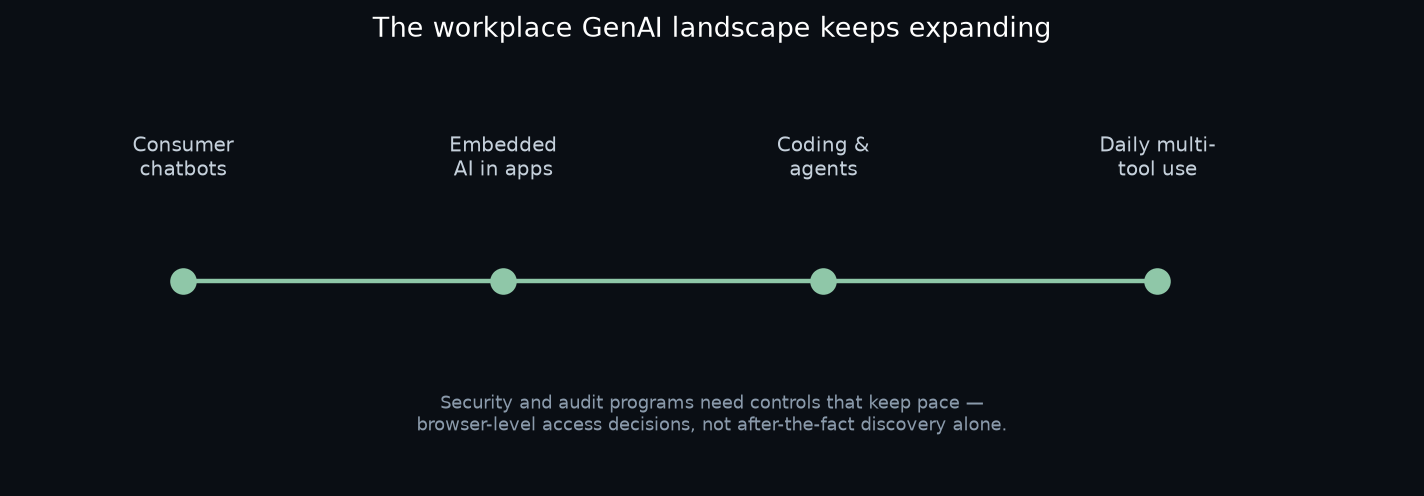
Infographic showing the expansion of workplace GenAI from consumer chatbots to daily multi-tool use, emphasizing the need for browser-level access controls.
Security and audit programs need controls that keep pace — browser-level access decisions, not after-the-fact discovery alone.

Security programs need controls that match that reality: decide access in real time, verify identity (SSO), and keep a record — not only write a policy memo.

Browser-level control, not after-the-fact discovery alone

A bridge to the product — educational framing, not a hard sell.

Access Control

Browser-level GenAI gating

GenAI Access Control & Data Security at the point of use — where shadow AI actually happens.

Identity

SSO-verified sessions only

Verified sessions proceed; the rest are blocked by policy before data can leave into an unapproved tool.

Evidence

Audit trail for review

Allowed, blocked, and flagged events support review and response when security teams need a record.

Fit

Complements existing stacks

One extension alongside the tooling you already run — without claiming to replace every control you have.

No FERPA, SOC 2, GDPR, or similar “compliant” claims — and no guarantee of preventing every leak. Controls reduce uncontrolled access; they do not erase every risk.

Close the gap between awareness and control

See how audits use allow/block evidence, walk through How It Works, or browse the living AI Platforms catalog.

Request a Demo

See Security Audits · How It Works · Browse AI Platforms